





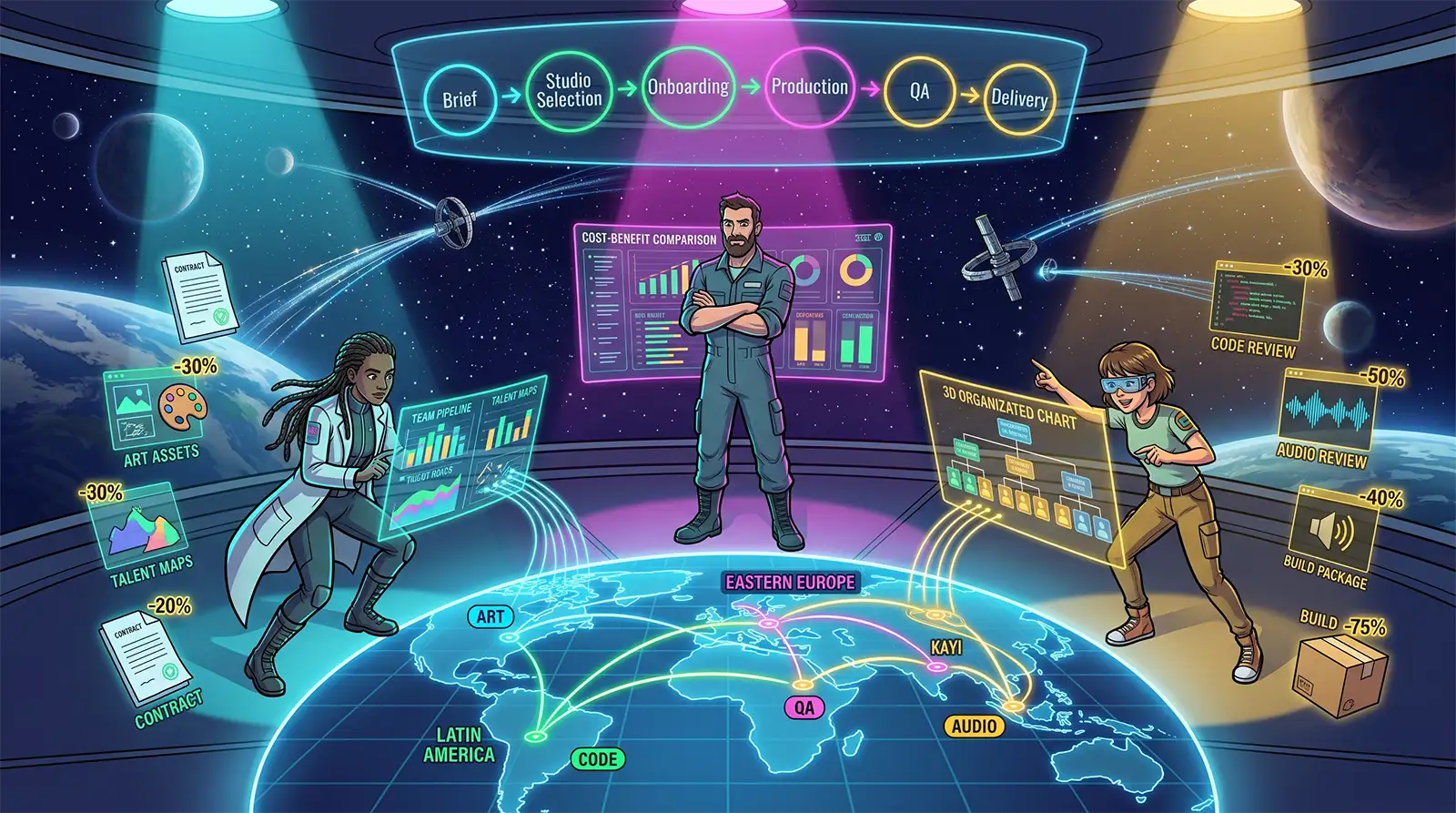
Complete Guide to Game Development Outsourcing in 2026
Mobile game development outsourcing is the practice of hiring an external studio or team to handle part or all of a mobile game's production. In 2026, that scope covers programming, art production, QA, backend infrastructure, LiveOps support, and UI/UX design. The global game development outsourcing market was valued at $2.21 billion in 2026 and is projected to reach $7.23 billion by 2035, driven by studios choosing specialized partners over building every system in-house.
Mobile outsourcing is not a subset of general game outsourcing. It operates under a distinct set of constraints: tighter production cycles, platform-specific technical requirements, genre conventions that move fast, and a monetization logic tied directly to behavioral psychology and session design. A studio outsourcing a PC RPG and a studio outsourcing a mobile casual game are solving fundamentally different problems.
In 2026, mobile gaming remains the largest segment of the global games market, generating over $90 billion annually and accounting for more than half of total game revenue worldwide. The demand for mobile development capacity has never been higher. The complexity of finding the right external partner to meet it has never been greater.
This guide covers everything that matters for the mobile context specifically: what outsourcing is and when it makes sense, the models, the regions, the costs, the process, the legal frameworks, how to shortlist and evaluate companies, and the criteria that separate partners worth hiring from vendors worth avoiding.
What this guide covers:
-
What mobile game development outsourcing is (and when it makes sense)
-
Outsourcing vs. building in-house: the real cost comparison
-
Engagement models and which fits your project
-
Regional comparison with rates and mobile-specific strengths
-
Full cost ranges by game type, including multiplayer and live-service
-
Step-by-step outsourcing process
-
Legal, IP, and contract essentials
-
How to shortlist and evaluate mobile game development companies
-
Vetting checklist and failure mode analysis
Top Game Development Outsourcing Companies in 2026: Quick Comparison
The top game development outsourcing companies in 2026 include Galaxy4Games, Juego Studios, Starloop Studios, N-iX Games, Whimsy Games, Keywords Studios, Kevuru Games, and Amber Studio. Each serves different budget tiers, genres, and engagement models - the comparison below covers the key differentiators.
|
Studio |
Specialty |
Best For |
Budget Range |
LiveOps |
|---|---|---|---|---|
|
Galaxy4Games |
Full-cycle, casual, mid-core, rpgs, LiveOps |
Mobile-first, multi-platform, ROI-focused |
$10K-$500K+ |
Deep (own live titles) |
|
Juego Studios |
Co-dev, full-cycle |
High-volume, cost-efficient |
$25K-$500K+ |
Standard |
|
Starloop Studios |
Multi-discipline, AAA support |
Large publishers, multi-platform |
$10K-$500K+ |
Standard |
|
N-iX Games |
Technical, multiplayer, Unreal |
Complex backends, engineering-heavy |
$100K-$1M+ |
Standard |
|
Whimsy Games |
Flexible scope, hybrid model |
Startups, indie, Western-facing |
$30K-$300K |
Standard |
|
Keywords Studios |
Art, QA, localization, LiveOps |
Specialist services, enterprise |
Custom / undisclosed |
Standard |
|
Kevuru Games |
Art-heavy, 3D, full-cycle |
Visual production, AAA co-dev |
$70K-$400K+ |
Limited |
|
Amber Studio |
Co-dev, AAA art, full-service |
Large IP holders, AAA publishers |
Custom / undisclosed |
Standard |
Note on budget ranges: Figures reflect publicly available data from studio websites, Clutch, and GoodFirms as of 2026. Keywords Studios and Amber Studio do not publish pricing - both operate on custom enterprise quotes. Actual project costs for any studio depend heavily on scope, platform, team size, and engagement model.
The detailed profiles for each studio - including team size, genre fit, LiveOps depth, and vetting criteria - are covered in the Notable Mobile Game Development Outsourcing Companies section below.
When to Outsource Mobile Game Development (and When Not To)
Not every studio should outsource, and not every project is suited to it. The decision hinges on three variables: internal capacity, timeline pressure, and the specialization gap between what you have and what the project requires.
Outsourcing makes sense when:
-
You lack in-house mobile expertise. Building a hypercasual title without a team that has shipped hypercasual titles is a high-risk proposition. Outsourcing fills that gap immediately.
-
You need to scale fast without a hiring cycle. Recruiting a senior Unity developer takes an average of 42 days. Onboarding adds another 3 to 6 months before full productivity. An experienced project with a game development outsourcing partner is operational in days.
-
You are running parallel projects. Studios with multiple titles in production use outsourcing to extend capacity without expanding fixed headcount.
-
The project has a defined scope. Fixed-scope projects (an MVP, a port, a specific feature set) are well-suited to outsourcing because the deliverable is clear and the relationship has a natural end point.
-
You need specialized skills. Multiplayer backend infrastructure, rewarded ad integration, ASO optimization, and LiveOps tooling are specialized disciplines. The team that builds your core game is rarely the best team for all of these.
Building in-house makes more sense when:
-
You have a stable, long-term roadmap and need consistent team continuity across multiple titles.
-
Your game involves highly proprietary systems where IP exposure is a primary concern.
-
You are building internal institutional knowledge that will compound across projects over years.
-
Your team already has the specific genre and platform expertise the project requires.
The cost reality
The financial case for outsourcing is strongest for studios without an existing mobile team. A five-person in-house mobile development team in the US or UK carries an annual cost of $430,000 to $650,000 in salaries alone, before accounting for office space ($40,000-$80,000/year), software licenses ($20,000-$50,000/year), benefits and insurance (20-30% of salary), and recruitment costs ($25,000-$65,000 per hire). Outsourcing to an experienced Eastern European or Latin American studio typically reduces total development cost by 30-40% compared to equivalent in-house capacity, with no fixed overhead and the ability to scale up or down as the project demands.
The key insight: outsourcing is not inherently cheaper for every project. It is structurally cheaper for projects with defined scope, specialized requirements, or tight timelines where the alternative is a costly and slow hiring cycle.
The Mobile-Specific Outsourcing Challenge
What makes mobile outsourcing distinctly complex is the intersection of speed and precision it requires.
Mobile games live and die by their first-week metrics. Day 1 retention benchmarks, session length, and early monetization signals determine whether a title gets scaled with UA spend or quietly shelved. This means every production decision, from onboarding flow to economy design to ad placement, carries commercial weight from day one.
An outsourcing partner that lacks genuine mobile experience does not just slow production. They make decisions that look technically correct but are commercially wrong:
-
An onboarding flow that takes 90 seconds instead of 45
-
A progression system that rewards too slowly
-
An ad integration that breaks session feel
-
A paywall placed before the player has experienced enough value to convert
These are not abstract problems. They are the specific failure modes that kill mobile games before they ever reach scale. The right mobile outsourcing partner understands this intuitively. They have seen these failure modes before, they know what the benchmarks look like, and they build with those constraints in mind from the start.
The part most guides miss: genre specificity within mobile is as important as mobile experience itself. The behavioral targets, design conventions, and monetization logic of a hypercasual game are meaningfully different from those of a mid-core RPG or a social casino title. A studio with strong strategy game credentials building a hypercasual title will produce something technically functional and behaviorally wrong. Mobile experience is the baseline. Genre experience is the filter.
Before evaluating specific engagement structures, it helps to understand how does game development outsourcing work at a foundational level. Studios engage external partners to own defined production scopes — whether a single discipline, a full project, or ongoing post-launch operations. The main game outsourcing models differ in how much production ownership transfers externally and how deeply teams integrate. Full-cycle vs co-development outsourcing is the most fundamental structural choice: full-cycle transfers complete production responsibility to the external studio, while co-development distributes ownership across internal and external teams with clearly defined accountability splits.
Engagement Models for Mobile Game Outsourcing
Choosing the right engagement model is the first structural decision in any outsourcing relationship. For mobile specifically, the model shapes not just the production dynamic but the post-launch one as well.
Full-Cycle Mobile Development
The external studio handles the entire project: concept refinement, game design, art production, engineering, QA, soft launch, and live support. This model suits publishers or IP holders without an internal mobile development team, or studios running parallel projects at capacity.
The critical factor in full-cycle mobile outsourcing is genre alignment. A studio with strong RPG or strategy credentials but limited casual or hypercasual experience will produce a technically functional game that misses the behavioral targets that matter in mobile. Genre experience is not a secondary credential. It is a primary filter.
Co-Development
Internal and external teams share production responsibility across specific disciplines. This is the most common model for mid-size mobile studios that have creative leadership but need to expand engineering, art, or LiveOps capacity without a full internal hire cycle.
Co-development in mobile requires especially clear ownership boundaries. The pace of mobile production, sprint-based, data-driven, constantly reacting to live metrics, makes ambiguity expensive. When both teams are making decisions about the same systems without clear accountability, conflicts compound quickly. Galaxy4Games' co-development model is built around explicit ownership splits defined before production begins.
Specialized Mobile Services
Rather than outsourcing the full game or co-developing it, studios engage specialized external teams for specific mobile verticals: UA creative production, rewarded video integration, push notification strategy, ASO optimization, or LiveOps event execution.
This model is growing because mobile specialization is real. The team best positioned to build your core game systems is not necessarily the team best positioned to run your seasonal event calendar or optimize your ad monetization stack.
Ongoing LiveOps Production
Post-launch mobile games require a continuous production pipeline: new content, balance updates, limited-time events, seasonal campaigns, and feature expansions. Many studios outsource this ongoing production capacity to external teams once the game is live, maintaining internal focus on the core product roadmap while the external partner sustains the content velocity the live game demands.
|
Engagement Model |
Best For |
Key Risk |
Mobile Fit |
|
Full-Cycle |
No internal mobile team; IP holders |
Genre mismatch if studio lacks mobile depth |
High, if genre-aligned |
|
Co-Development |
Studios with creative leadership needing capacity |
Ownership ambiguity without clear splits |
Very high for live-service |
|
Specialized Services |
Specific verticals (UA, ASO, LiveOps) |
Fragmented accountability across vendors |
High for mature titles |
|
Ongoing LiveOps |
Post-launch content velocity |
Content quality drift over time |
Essential for live games |
Regional Comparison: Where to Outsource Mobile Game Development
Region selection in mobile outsourcing is a decision with real consequences for cost, quality, communication, and production speed. Each major outsourcing region has genuine strengths and genuine limitations.
|
Region |
Avg. Rate (USD/hr) |
Mobile Strengths |
Key Considerations |
|
Eastern Europe |
$40-$80 |
Engineering depth, Unity/Unreal expertise, strong QA culture |
Higher rates than Asia; time zone can require structured async workflows |
|
Southeast Asia |
$20-$55 |
Art production, hypercasual experience, mobile-first studios |
Quality range is wide; requires rigorous vetting and clear briefs |
|
Latin America |
$25-$65 |
US time zone alignment, cultural fit, growing mobile talent pool |
Ecosystem less mature than Eastern Europe; top studios book fast |
|
South Asia |
$15-$45 |
Scale, engineering volume, cost efficiency |
Management overhead significant; works best with strong internal PM |
|
China |
$30-$70 |
Mobile-native production, massive genre expertise |
IP protection concerns; communication barriers in some contexts |
|
Western Europe / North America |
$85-$160+ |
Premium execution, deep mobile market understanding |
Cost rarely justifies for high-volume production work |
How to actually use the regional table
The hourly rate column reflects the economic conditions of a country, not the quality of the work produced. In 2026, development teams are routinely distributed across multiple countries, talent is globally mobile, and the old "Eastern Europe = engineering depth, Southeast Asia = art production" specialization map no longer reflects how studios actually operate. A studio registered in Tallinn may have engineers in Kyiv, artists in Tbilisi, and a PM in Berlin. Treating geography as a proxy for capability is a shortcut that consistently produces bad hiring decisions.
The variables that actually matter when selecting a region are different:
Cultural alignment and communication style
This is underweighted in most outsourcing decisions and overdelivers on outcome. Cultural alignment affects how feedback is received, how ambiguity is handled, how disagreement is surfaced, and how fast decisions move. A studio that communicates directly, flags problems early, and pushes back on bad ideas is a fundamentally different working experience than one that confirms everything in writing and delivers surprises at milestone reviews.
This is not a geography question - it is a studio-level question. But regional business cultures do create tendencies worth understanding before the first call.
Language fluency under pressure
English proficiency scores tell you nothing useful. What matters is whether the team can communicate clearly when the brief is ambiguous, when something goes wrong mid-sprint, or when a design decision needs to be challenged. Fluency under pressure - in async written communication, in live calls, in technical documentation - is the variable to evaluate. Ask for a sample of their written async communication from a past project. How they write when it matters is how they will write when it matters for you.
Time zone: overlap is not always the goal
The conventional logic is that maximum time zone overlap equals maximum collaboration. This is often wrong. For mobile game development specifically, where deep engineering work, art production, and QA all require uninterrupted focus time, a meaningful time zone gap can be a structural advantage.
A studio operating 6-8 hours ahead of your team can complete a full production cycle while your team sleeps, surface results for morning review, and receive direction before their next working day begins. This creates a continuous production loop that real-time-overlap teams often cannot match. The key requirement is disciplined async communication: clear written briefs, structured handoffs, and milestone-based accountability rather than meeting-heavy coordination.
Where real-time overlap genuinely matters is in creative direction sessions, design reviews, and problem-solving calls. For those, 2-4 hours of daily overlap is sufficient. Full time zone alignment is rarely necessary and sometimes counterproductive.
Legal and business environment
Contract enforceability, IP jurisdiction, and payment infrastructure vary significantly by country and matter more than most clients anticipate before they need them. A studio in a country with strong commercial law, clear IP assignment frameworks, and straightforward international payment infrastructure reduces legal friction significantly. This is worth a conversation with your legal counsel before signing with any partner, regardless of region.
Cost Ranges for Mobile Game Outsourcing
Cost estimates in mobile outsourcing vary significantly based on scope, region, genre complexity, and engagement model. The following ranges reflect current market reality for complete mobile game development projects.
|
Project Type |
Estimated Cost Range |
Timeline |
Notes |
|
Hypercasual MVP |
$30,000-$80,000 |
1-3 months |
Core loop only; minimal art complexity |
|
Casual Mobile MVP |
$60,000-$150,000 |
3-5 months |
Full onboarding, basic progression, monetization signal |
|
Mid-Core Mobile (MVP) |
$100,000-$300,000 |
5-9 months |
Deeper systems; meta progression; longer timeline |
|
Full Casual Game (Launch-Ready) |
$200,000-$500,000+ |
6-12 months |
Complete content, economy, onboarding, QA |
|
Multiplayer / Live-Service Mobile |
$300,000-$2,000,000+ |
10-24 months |
Backend infrastructure, matchmaking, in-game economy, LiveOps tooling |
|
Ongoing LiveOps (Monthly) |
$15,000-$60,000/mo |
Ongoing |
Varies by content velocity and team size |
What actually drives cost
The biggest cost variable in mobile outsourcing is not the hourly rate. It is the rework multiplier: how much budget goes toward rebuilding poorly defined or executed systems. Studios that invest in a proper discovery phase and a detailed scope document before production begins consistently spend less in total than those who start fast and revise continuously.
Cost drivers to understand:
-
Platform scope. iOS-only development costs roughly 20-30% less than dual-platform (iOS + Android) because Android's device fragmentation requires substantially more QA coverage.
-
Art complexity. Hypercasual titles with minimal art assets cost a fraction of mid-core titles with character rigs, animation sets, and environment art.
-
Backend requirements. Multiplayer infrastructure, real-time leaderboards, and social features add significant engineering cost. A casual puzzle game and a multiplayer battle game at the same "mid-core" label can differ by $200,000 or more in total cost.
-
LiveOps architecture. Games built with LiveOps in mind from day one cost less to operate post-launch than games where content management systems are retrofitted after release.
These ranges assume Eastern European or Latin American partners at mid-market rates. Southeast Asian partners can reduce costs by 30-40% at the expense of increased management overhead and vetting requirements. North American or Western European studios will push costs 50-80% higher than the ranges above.
The Mobile Game Outsourcing Process: Step by Step
Understanding the process before starting it prevents the most common and most costly mistakes in mobile outsourcing relationships.
Step 1: Define the Mobile-Specific Scope
Before evaluating any partner, the studio needs a clear scope document that addresses mobile-specific parameters: target platform (iOS, Android, or both), target genre and subgenre, core loop definition, monetization model (IAP, ad-based, hybrid), session design targets, and soft launch geography.
A scope document that does not address these parameters will generate proposals that are incomparable and partnerships that are misaligned from day one. Vague briefs do not just slow things down. They produce games that miss their commercial targets because those targets were never clearly defined.
Step 2: Filter for Mobile Genre Experience
The partner shortlist should be filtered first by direct experience in the target genre. A studio pitching mobile casual game development should have shipped multiple casual titles, understand D1/D7 retention benchmarks for that genre, and be able to speak specifically about onboarding design, session length optimization, and monetization cadence.
Generic mobile experience is not the same as genre-specific mobile experience.
Step 3: Evaluate Production Infrastructure
Mobile game outsourcing partners should have demonstrable production infrastructure, not just talent. This includes version control systems, QA pipelines, build automation, analytics integration capability, and a process for managing iterative updates in a live game context.
Partners without this infrastructure create dependency and fragility. Every update becomes a custom project rather than a pipeline operation. Ask specifically about their analytics integration approach. Partners who instrument analytics after the fact are a significant red flag in mobile development.
Step 4: Run a Paid Discovery or Pilot
Before committing to a full engagement, run a structured paid discovery phase or a small pilot project. This surfaces real production capabilities: communication quality, brief interpretation, revision responsiveness, and decision-making under ambiguity, before the stakes are high.
Studios that skip this step and proceed directly to full engagement based on portfolio reviews and sales calls consistently report higher rates of mid-production misalignment. A two-to-four-week paid discovery is the most valuable investment you make before full production begins.
Step 5: Establish Milestone-Based Payments
Structure payments around specific deliverables rather than time periods. This aligns incentives and provides natural checkpoints to assess progress. A typical milestone payment structure for mobile game outsourcing:
-
Concept and design approval: 15-20%
-
Core mechanics prototype: 25-30%
-
Alpha build: 20-25%
-
Beta and polish: 20-25%
-
Final delivery and store submission: 10-15%
Step 6: Establish Mobile-Specific KPIs for the Partnership
The engagement should be governed by clear mobile-specific KPIs from the start: delivery timelines, quality benchmarks, revision limits, communication cadence, and, for live engagements, content velocity targets and LiveOps responsiveness standards.
Without these agreements in place, both sides evaluate the partnership against different standards, and disputes become inevitable.
Legal, IP, and Contract Essentials
Legal preparation is one of the most consistently skipped steps in mobile outsourcing relationships, and one of the most consequential when things go wrong. Before any proprietary materials change hands, the following agreements must be in place.
Non-Disclosure Agreement (NDA)
An NDA should be signed before the first scoping call where you share any proprietary information about your game concept, mechanics, or business strategy. A well-drafted NDA covers:
-
Definition of confidential information (code, design documents, business data, player data)
-
Duration of confidentiality obligations (typically 2-5 years post-project)
-
Permitted disclosures (subcontractors the partner may need to involve)
-
Jurisdiction and governing law
Do not rely on a generic template. Have the NDA reviewed for the specific jurisdiction of your outsourcing partner.
IP Assignment Agreement
This is the most critical document in any outsourcing engagement. Without a clear IP assignment agreement, ownership of the code, art assets, and game systems your partner produces may be legally ambiguous, even if you paid for them.
A proper IP assignment agreement establishes:
-
All work produced under the engagement is a "work made for hire" owned by the client
-
All pre-existing IP the partner brings to the project (including their own tools and frameworks) is clearly licensed to you, not assigned
-
Any third-party assets or middleware used must be disclosed and properly licensed
-
IP assignment takes effect upon final payment
The pre-existing IP issue is frequently overlooked. If your partner uses their own proprietary engine components, modular systems, or middleware, you need a perpetual license to use those components in your game, not just a transfer of the custom work they built on top of them.
Service Agreement and Scope of Work
The service agreement governs the commercial relationship. For mobile outsourcing, it should include:
-
Detailed scope of work with feature-level specificity
-
Milestone definitions and acceptance criteria
-
Revision and change request process (how many revision rounds are included, what triggers a scope change)
-
Payment schedule tied to milestone delivery
-
Warranties on delivered work (bug-fix obligations, performance standards)
-
Termination clauses and IP disposition on termination
-
Liability caps and indemnification
Data Protection
If your game collects any player data (which virtually all mobile games do), your service agreement must address data processing responsibilities, GDPR compliance for European players, and data security obligations. This is not optional. Regulatory penalties for data protection failures apply to the game publisher, regardless of who built the data collection systems.
Key takeaway: Sign the NDA and IP assignment agreement before sharing any game design documents, concept art, or technical specifications. These are not bureaucratic formalities. They are the documents that determine who owns what if the relationship ends badly.
How to Shortlist Mobile Game Development Outsourcing Companies
The market for mobile game development outsourcing companies is large and uneven. Portfolio quality varies enormously, and many studios present themselves as full-service mobile developers when their actual shipped experience is narrow. A structured shortlisting process cuts through the noise.
Where to find candidates
-
Clutch and GoodFirms: verified client reviews with budget, timeline, and outcome data. Useful for initial screening.
-
Industry referrals: the most reliable source. Studios that have shipped mobile games know who else has.
-
Direct portfolio research: search the App Store and Google Play for games in your target genre, then identify who built them. A studio with a live game you can download and play is a fundamentally different proposition from a studio with portfolio screenshots.
The shortlisting framework
Limit your shortlist to three to five studios. More than five creates evaluation overhead that reduces decision quality. The evaluation process is time-intensive; volume does not improve outcomes.
Filter in this order:
-
Genre match first. Does this studio have shipped titles in your specific genre? Not "mobile games" generically. Your genre specifically.
-
Platform experience. iOS, Android, or both? Have they handled the platform compliance and store submission process before?
-
Scale fit. Is your project scope (budget, team size required, timeline) within the range this studio typically operates? A studio built for $500,000+ projects will not give a $60,000 MVP the attention it needs.
-
LiveOps capability. Have they supported a game post-launch? Can they describe their live operations process?
-
Verified reviews. Not testimonials on their own website. Third-party verified reviews on Clutch or GoodFirms that include budget ranges and project outcomes.
How to evaluate proposals
When you have your shortlist, request a scoping call, not a quote. The best studios want to understand your project before they put a number on it. A studio that sends a price list before asking a single question is not running a professional process.
When proposals arrive, evaluate them on:
|
Evaluation Criterion |
Green Flag |
Red Flag |
|
Milestone structure |
Detailed deliverables per milestone |
Lump sum or vague phases |
|
Genre references |
Specific titles with retention data |
Generic portfolio claims |
|
Analytics approach |
Instrumented from day one |
"We can add analytics later" |
|
Monetization experience |
IAP flow, paywall design, ARPU targets |
"We integrate your monetization SDK" |
|
Post-launch capability |
Defined LiveOps process |
No post-launch offering |
|
Capacity transparency |
Specific team allocation |
Vague "dedicated team" language |
The request that separates serious studios from the rest: ask for retention benchmarks from titles they have shipped in your genre. A studio that has shipped hypercasual titles knows what D1 and D7 retention look like for that genre. A studio that cannot answer this question has not shipped in that genre, regardless of what their portfolio page says.
Notable Mobile Game Development Outsourcing Companies
The market for mobile game development outsourcing companies is large, fragmented, and uneven in quality. The studios below represent meaningfully different models - each with a distinct profile, a genuine differentiator, and a clear fit for a specific type of buyer. This is not a ranked list. It is a structured comparison to help you understand what you are actually choosing between.
How to use this section: Read each studio profile against your own project requirements: team size, budget tier, genre, and whether you need a partner through launch only or through the live phase as well. The right choice depends on the fit, not the ranking.
Starloop Studios
HQ: Spain (part of Magic Media group) | Team: 1,000+ across 14 countries | Founded: 2011
Starloop operates as part of Magic Media, a large international group spanning game development, VFX, cybersecurity, and video production. That scale is both the differentiator and the caveat. Studios that need access to a broad range of production disciplines under one umbrella - art, animation, VFX, QA, engineering - can consolidate vendor relationships through Starloop. Their portfolio includes over 300 shipped titles across mobile, PC, console, and VR/AR, with clients including Ubisoft, Disney, and Kiloo.
Best for: Studios or publishers that need multi-discipline production support at scale, or that are already working within the Magic Media ecosystem.
Watch for: At 1,000+ people across 14 countries, team consistency and direct communication require active management. Boutique-level attention is not the default at this scale.
Juego Studios
HQ: Bangalore, India | Team: 250-300 specialists | Founded: 2013
Juego positions itself as a co-development and full-cycle partner with particular depth in mobile, PC, and console across a 500+ title portfolio. Their stated differentiator is production governance: integrating engineering, art, and LiveOps into a unified pipeline rather than treating them as separate deliverables. For studios managing complex roadmaps with multiple simultaneous workstreams, that integration reduces handoff friction. Rates starting around $18-25/hour make them one of the more accessible options at mid-tier budget.
Best for: Studios with defined roadmaps that need a high-volume, cost-efficient partner for full-cycle or co-development work across mobile and PC.
Watch for: At $18-25/hour, the cost efficiency is real - but so is the management overhead. Juego works best when the client has strong internal production leadership to govern the engagement.
Whimsy Games
HQ: London / Ukraine | Team: 50-100 | Founded: 2016
Whimsy operates a hybrid model: London-based project management with distributed development talent across Europe. That structure gives clients Western-facing communication and contract familiarity while avoiding full Western-rate pricing. With 89 clients and shipped titles for Playrix, Samsung, and Plarium, they operate squarely in the startup-to-mid-publisher segment. Their iterative development approach suits projects that evolve during production rather than arriving with a fixed, complete brief.
Best for: Startups and indie publishers that need direct communication, flexible scope management, and a Western-facing point of contact without paying full Western rates.
Watch for: Whimsy's sweet spot is clearly scoped small-to-mid projects. For larger budgets or complex live-service requirements, their team size becomes a constraint.
N-iX Games
HQ: Ukraine (offices in EU and USA) | Team: 240+ specialists | Founded: 2012
N-iX Games is the game development division of N-iX, a large European software engineering company. That parentage gives them unusual technical depth for a game studio: dedicated Unity and Unreal departments, strong backend engineering capability, and a track record with technically demanding clients including Netflix, Wargaming, Blizzard, and Paradox Interactive. Their Netflix engagement is particularly instructive - they ran parallel dedicated teams across multiple titles, delivering an average 10-14 month cycle per content-rich narrative game.
Best for: Publishers and studios with technically complex projects - multiplayer backends, cross-platform parity, high-fidelity 3D - where engineering depth matters as much as game design experience.
Watch for: N-iX's heritage is software engineering first, game development second. For casual mobile titles where behavioral design and monetization architecture are the primary variables, a mobile-native studio may be a better fit.
Galaxy4Games
HQ: Tallinn, Estonia | Team: 40 senior specialists | Founded: 2010+
Galaxy4Games occupies a specific position in this market: a boutique full-cycle studio that both builds client games and operates its own live titles on the App Store and Google Play. That combination is rare and consequential. Most outsourcing studios build games for clients. Galaxy4Games also runs them, which means every client engagement is informed by the real operational experience of managing live retention, updating content cadences, monitoring monetization signals, and responding to store compliance changes.
The production foundation reflects this. Every project can begin with a proprietary Game Application Template - pre-built core architecture, platform integrations, analytics hooks, and store compliance scaffolding - and developed further from a modular solutions library of battle-tested, plug-in-ready game features. The result is 30-50% faster development compared to building from scratch, with a LiveOps-ready architecture from day one rather than retrofitted after launch.
Best for: ROI-focused entrepreneurs, startups, and publishers who need a partner that thinks in metrics and commercial outcomes, not just milestone delivery. Particularly strong for casual, mid-core, and live-service mobile titles where post-launch operational performance is as important as the build itself.
What makes it different: Galaxy4Games is the only studio in this comparison that operates its own live mobile games. That is not a marketing claim - it is a structural difference in how they approach every production decision.
|
Studio |
Team Size |
Best Budget Fit |
Mobile-Native |
Own Live Games |
LiveOps Depth |
|
Starloop Studios |
1,000+ |
$100K+ |
Yes |
No (publicly verified) |
Standard |
|
Juego Studios |
250-300 |
$50K-$500K |
Yes |
No (publicly verified) |
Standard |
|
Whimsy Games |
50-100 |
$30K-$300K |
Yes |
No (publicly verified) |
Standard |
|
N-iX Games |
240+ |
$150K+ |
Partial |
No (publicly verified) |
Standard |
|
Galaxy4Games |
40 |
$30K-$500K |
Yes |
Yes (App Store + Google Play) |
Deep, operator-led |
If you want to go deeper on partner selection, explore our top game development companies for hire, or for teams that need everything built end-to-end, our roundup of full-cycle outsourcing studios.